
New Program
PhD in Life Coaching
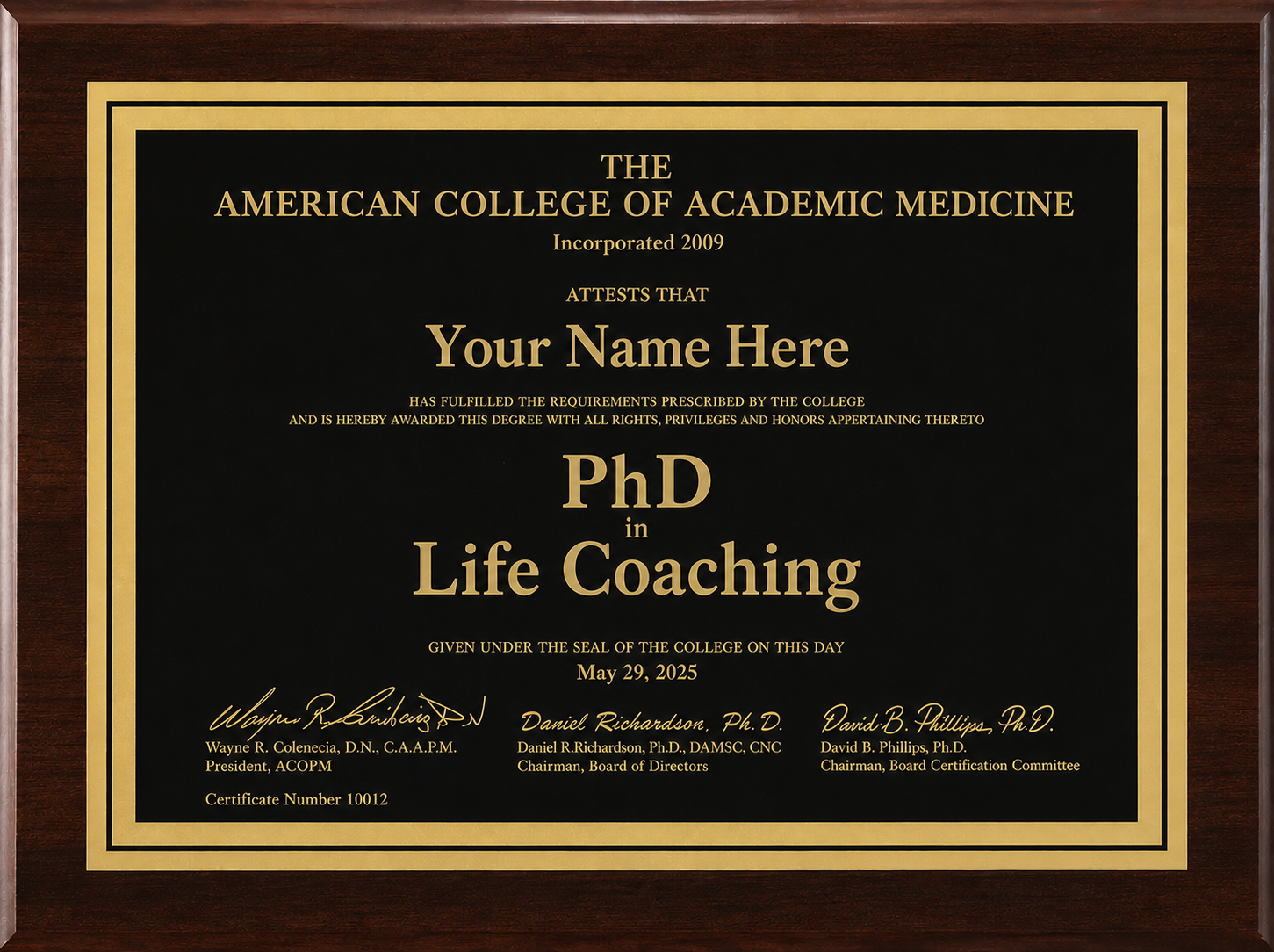
A self-paced, ten-section doctoral program in the science and practice of life coaching — developed under the instruction of Dr. David B. Phillips, MD · PhD, and awarded by the American College of Academic Medicine. Study online, on your schedule, and complete your final exam when you're ready.
Program Overview
The PhD in Life Coaching is a ten-section online program developed under the instruction of Dr. David B. Phillips, MD · PhD. It prepares students to practice coaching ethically and effectively across a wide range of settings — grounded in current research, established behavior-change models, and professional best practices.
The program is fully self-paced. Course materials are available online upon enrollment, so you can study whenever it suits your schedule. Each of the ten sections concludes with a quiz, and the program culminates in an online final examination, also taken at your convenience.
Instruction covers the full arc of a coaching practice: foundational skills and frameworks, ethics and professional standards, evidence-based methods, and specialized applications in health and wellness, leadership, cross-cultural, and community contexts.
Curriculum
1. Foundations of Life Coaching — What coaching is (and isn't), the coach-client relationship, core principles, and professional boundaries.
2. Theoretical Models & Frameworks — Coaching psychology, behavior-change theory, and cognitive-behavioral, positive-psychology, and solution-focused approaches.
3. Advanced Coaching Skills — Active listening, powerful questioning, goal-setting frameworks, accountability, and mindfulness-based tools.
4. Ethics & Professional Standards — Ethical codes, confidentiality, boundaries, inclusion, and resolving ethical dilemmas in practice.
5. Research Methods in Coaching — Evidence-based practice, gathering and interpreting client feedback, and reflective evaluation.
6. Health & Wellness Coaching — Lifestyle change, supporting clients with chronic conditions, and collaborating with healthcare professionals.
7. Coaching in Diverse & Global Contexts — Cultural competence, communication across differences, and serving varied communities.
8. Leadership & Organizational Coaching — Leadership development, team effectiveness, change management, and measuring impact.
9. Professional Development & Supervision — Building a sustainable practice, supervision and peer review, and preventing burnout.
10. Coaching for Social Change — Community-impact frameworks, self-advocacy, and partnering with nonprofits and civic organizations.
Each section includes a quiz; the program concludes with an online final exam.
Who It's For
Enrollment is open — no prior degree, medical license, or coaching credential is required. The program is designed for:
Aspiring coaches — building a practice from the ground up, who want a structured, research-grounded foundation before taking on clients.
Practicing coaches — seeking to deepen their skills, formalize their knowledge, and add a doctoral-level credential to their professional profile.
Healthcare and wellness professionals — nurses, therapists, chiropractors, physical therapists, nutritionists — who want to add coaching to the services they offer.
Leaders and consultants — who coach as part of their work in organizations, teams, and communities and want formal training behind it.
Because the program is self-paced and delivered entirely online, it fits around a working schedule — study on your own time and sit the final exam when you're ready.
Tuition & Enrollment
[PLACEHOLDER: price]
The PhD in Life Coaching is a private certification awarded by the American College of Academic Medicine based on examination of the candidate's knowledge. The College is not accredited by an accrediting agency recognized by the U.S. Department of Education, and this program is not a substitute for a university degree. It does not qualify recipients to practice medicine, psychology, or any licensed profession, or to use professional titles regulated by state law. Life coaching itself is an unlicensed field; graduates are responsible for complying with the laws of their jurisdiction.